
Patient Management Web Portal for a Clinic Network
Let's Connect
Overview
What we built
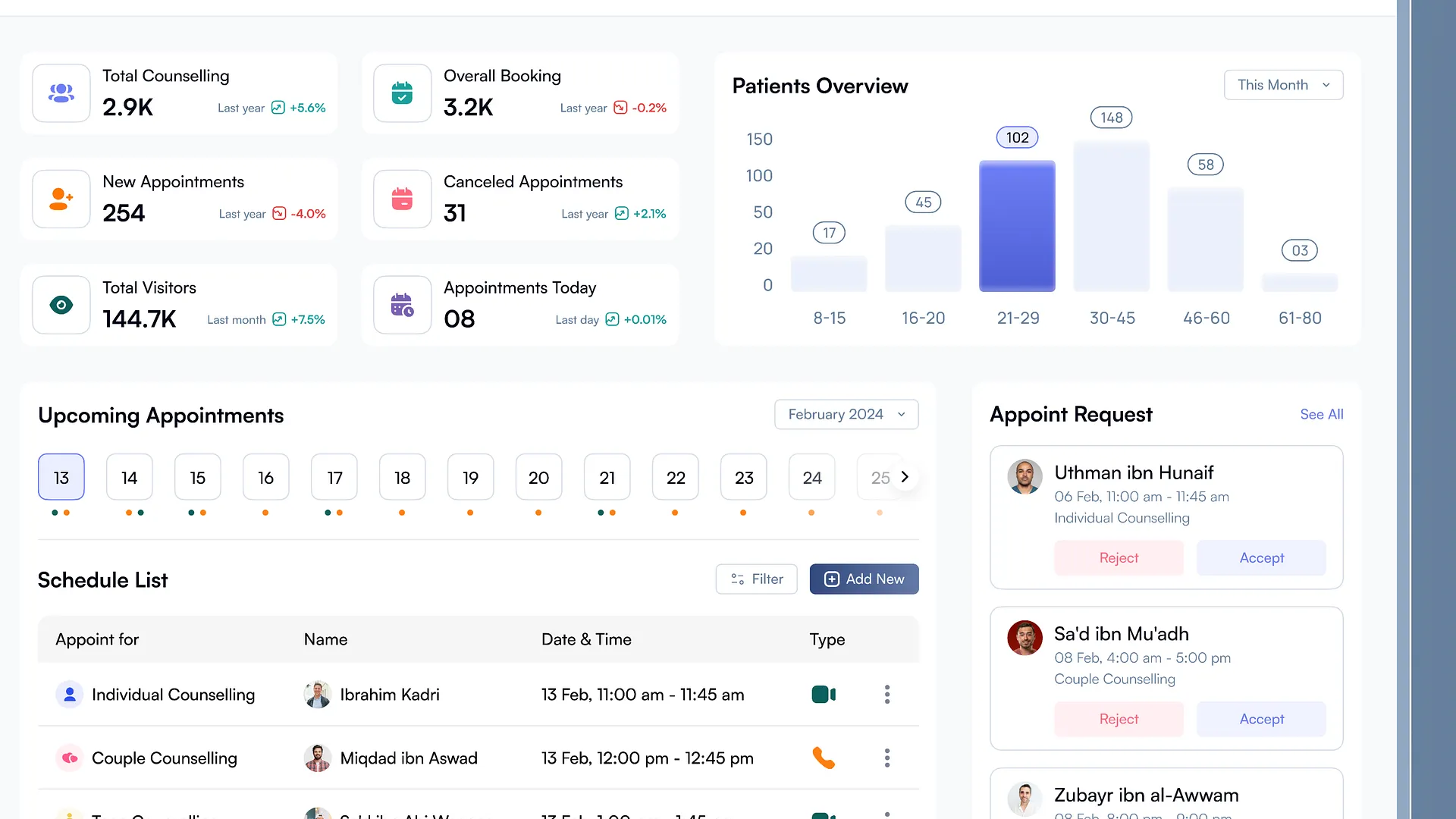
A network of 6 private clinics was running on paper files, legacy desktop software and WhatsApp threads. We replaced that patchwork with one web portal for patients, doctors and administrators.
In plain terms: the clinics had no single place where patient information lived. Appointments, medical records and billing were spread across legacy desktop software, paper files and WhatsApp messages between doctors and reception staff. A patient could visit one branch and be all but invisible to the next, doctors prepared for consultations without the full picture, and every month the network spent days piecing billing back together from 6 sets of records.
We built one web-based patient management portal to replace all of it, with separate interfaces for patients, doctors and administrators, all reading from the same centralised data in real time across every clinic location. The change showed up quickly in the network's own numbers: online bookings reached 62% of all appointments within 10 weeks, consultation preparation time fell by 35%, month-end billing reconciliation dropped from 5 days to under 6 hours, and automated reminders cut the no-show rate by 31%.
The Problem
Paper records and WhatsApp coordination
The network had grown to 6 private clinics, but its record keeping had not grown with it. Each branch held patient information in a mix of legacy desktop software and paper files, and the gaps between systems were bridged the only way available: WhatsApp messages between doctors and reception staff. Nothing guaranteed that what one branch knew about a patient existed anywhere else.
For doctors, that meant preparing for consultations without a reliable history, especially for patients who had previously been seen at another branch. Reception staff spent their days relaying appointment details by chat, and there was no way for a patient to book online at all. Missed appointments went unaddressed because nothing in the setup could send a reminder.
Billing carried the same weight at month end. With every clinic holding its own figures in its own format, reconciliation meant collecting, checking and re-checking numbers across the network, a job that consumed 5 days of every month before the books could close.
Fragmented patient records
Medical histories lived partly on paper and partly in ageing desktop software, split by branch, with no single view of any patient across the network.
Chat as infrastructure
Doctors and reception staff coordinated appointments and handovers through WhatsApp messages, a channel with no structure, no audit trail and no connection to the records.
No online booking
Patients could not book, change or review appointments themselves, so every request passed through reception and every reminder depended on someone remembering to send it.
Month-end billing crunch
Each clinic's billing had to be reconciled by hand against the others at month end, stretching the close to 5 days of collecting and cross-checking figures.
What it was costing them
Every consultation started slower than it needed to, because the doctor first had to reconstruct the patient's history from whatever the branch held. Reception hours went into chat coordination instead of patients. Appointments were lost to no-shows that nothing was in place to prevent, and the finance side surrendered 5 days of every month to reconciliation before anyone could trust the numbers.
The Solution
One portal for every clinic
We built a web-based patient management portal for the whole network, designed around three roles rather than one generic login. Patients book and manage their appointments online and receive automated reminders. Doctors open a patient's centralised record and see the same history whichever branch the visit happens in. Administrators run scheduling and billing from inside the same system instead of around it.
Centralisation was the core decision. Every record, appointment and invoice is stored once and made accessible across all clinic locations in real time, so the portal did not just digitise the paper files, it removed the branch boundaries between them. A doctor covering a shift at another clinic sees exactly what a colleague at the patient's usual branch would see.
The rollout was as much about retiring old habits as launching new screens. Once bookings, handovers and billing lived in the portal, the WhatsApp threads between doctors and reception staff could stand down and the paper files stopped growing. Automated appointment reminders were switched on as part of the booking flow itself, so patients hear from the clinic without any member of staff having to remember them.
Key decisions
One record per patient
Patient data is centralised and shared across all branches, so a visit at any clinic reads from and writes to the same record.
Separate interfaces for each role
Patients, doctors and administrators each get a view shaped to their own work, instead of one cluttered system trying to serve everyone at once.
Real time across every branch
Updates made at one clinic are visible at all the others immediately, removing the lag that paper files and desktop software had built into the network.
Reminders inside the booking flow
Automated appointment reminders were made part of booking itself rather than a separate task, so no appointment depends on a member of staff remembering to chase it.
Billing in the same system
Invoicing lives alongside appointments and records, so month-end reconciliation draws on one consistent source instead of a different format per clinic.
Measurable Impact
What changed after launch
The numbers moved quickly. With cross-branch records available at the point of care, consultation preparation time fell by 35%. Online bookings, which had not existed at all before the portal, reached 62% of total bookings within 10 weeks. Automated reminders cut the patient no-show rate by 31%, recovering appointments the network had previously written off as a fact of life.
The quietest improvement may have mattered most to the people running the network: month-end billing reconciliation, previously a 5-day exercise in collecting and cross-checking figures, now completes in under 6 hours. For the first time the clinics share one operational picture, something the old mix of paper, desktop software and chat threads could never have produced.
Patient records
Paper files and desktop software, siloed per branch
One centralised record, preparation time down 35%
Appointment booking
Reception-handled only, coordinated over WhatsApp threads
62% of bookings made online within 10 weeks
Missed appointments
No reminders, no-shows absorbed as normal
Automated reminders, no-show rate down 31%
Billing close
5 days of manual month-end reconciliation
Reconciliation completed in under 6 hours
Headline results
Cross-branch patient record access reduced consultation preparation time by 35%
Online appointment bookings reached 62% of total bookings within 10 weeks
Month-end billing reconciliation reduced from 5 days to under 6 hours
Patient no-show rate reduced by 31% through automated appointment reminders
Ready to Build your Healthcare Business with custom-web-development
Ask Byte
Ask Byte
Typically replies instantly
just Now
Hi! I'm OrganByte's assistant. How can I help you today?
AI-generated content may be incorrect